What Current Space Weather Conditions Mean for the Artemis II Mission Crew

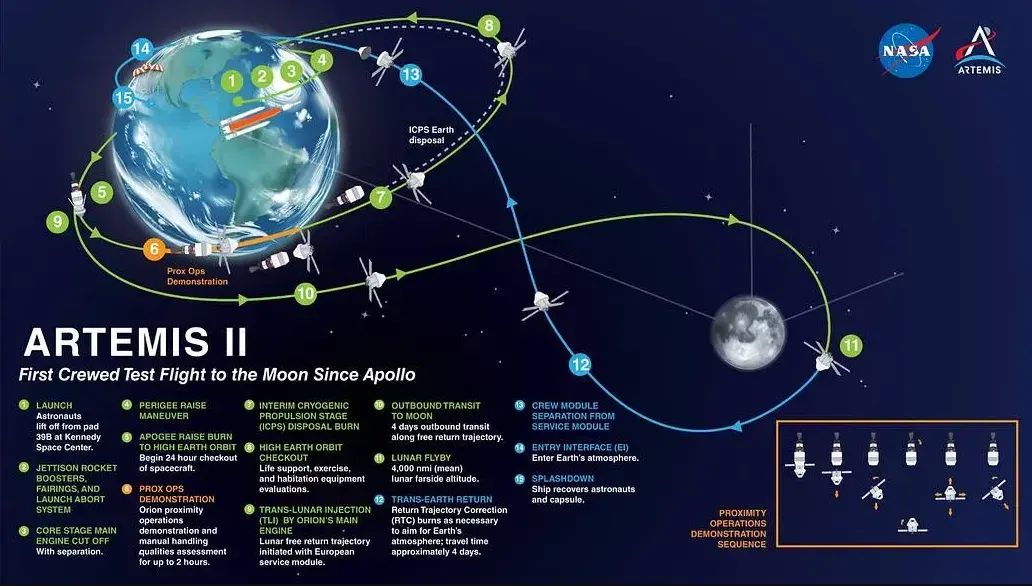
The world watched the launch. April 1, 2026. Four astronauts (Reid Wiseman, Victor Glover, Christina Koch, and Jeremy Hansen) lifted off from Kennedy Space Center aboard the Orion spacecraft on a 10-day mission around the Moon. First crewed mission beyond low Earth orbit since 1972. This is historic by every measure, the celebration was deserved. But in the space weather community, the launch was only the beginning of an intense 10-day watch.
How exposed is the crew?
On 2nd April, a day after launch, the Artemis II crew completed what is called a translunar injection burn. That burn pushed the Orion spacecraft (NASA's deep space crew vehicle carrying the Artemis II astronauts) beyond Earth's magnetosphere, the magnetic bubble surrounding our planet that deflects and absorbs most of the energetic particles the Sun throws into space. To put that in perspective, astronauts on the International Space Station operate within Low Earth Orbit, fully inside that bubble, depending on it to shield them from solar radiation. The Artemis II crew left it behind on April 2nd.
As of now, the crew is passing through Earth's magnetotail, a faint extension of Earth's Magnetosphere stretched away from the Sun by solar wind. The magnetotail is not the calm shelter it might sound like. It is an extremely dynamic region that expands and contracts in response to solar activity, offering some reduction in radiation exposure when conditions are stable, and no protection at all when they are not. During extreme storms, the magnetotail itself becomes a hazard, as magnetic fields within it can tangle and violently snap in a process called magnetic reconnection, releasing bursts of energy in the process.
It is worth noting that current solar activity, while elevated, does not yet meet that threshold. The crew remains safe. But once they move beyond the magnetotail entirely, there is nothing standing between them and whatever the Sun decides to do.
Solar radiation at that point is not a background risk monitored from a safe distance. It is the environment they will be living in.
The sun's activity since Artemis II left Earth's protection
Since the crew left the Earth's magnetosphere, two sunspot regions have been notably active. AR4409, carrying a complex beta-gamma magnetic configuration, has been the lead flare producer, firing the majority of events including an M-class flare on April 3. AR4404 produced the strongest single event of the period, an M3.5 on April 2. Both triggered R1 radio blackouts on the sunlit side of Earth. Forecasters are currently giving a 55% daily chance of M-class activity and a 20% chance of X-class flares, with AR4405, which already fired the powerful X1.5 flare on March 30, also still active on the sun's disk.
What the current M-class flares actually mean for the Artemis II crew
On the ground, an M-class solar flare causes radio blackouts. HF communications go down. GPS accuracy degrades. Navigation systems take a hit. These are real impacts that affect aviation, maritime operations, and systems like the GNSS receiver networks that space weather professionals monitor daily. Disruptive, but manageable, because Earth's magnetic field is absorbing most of the energy before it reaches us.
The Artemis II crew does not have that buffer anymore.
The primary concern for astronauts in deep space is not the flare itself. It is what flares and coronal mass ejections can trigger: solar particle events. These are bursts of high-energy protons and ions accelerated to near the speed of light that travel outward through space. They pass through metal. They pass through human tissue. They damage DNA at a cellular level.
Think of it less like a sudden explosion and more like interest accumulating on a debt. Each transaction looks small. It is only when you see the total that the weight of it becomes clear. Energetic particles spiral along magnetic field lines, arrive from every direction, and quietly build up radiation levels inside the spacecraft over hours. That gradual rise is actually what gives analysts on the ground time to assess the situation and coordinate a response before levels become dangerous.
Radiation in Deep Space: The Bigger Picture
A single M-class flare is unlikely to cause immediate harm. The concern is the total radiation dose accumulated over the mission, from the Van Allen Radiation Belts the crew passed through on the way out, from galactic cosmic rays arriving from beyond our solar system, and from any solar particle events that occur while they are in deep space. NASA expects the baseline exposure from this mission to be roughly equivalent to a one-month stay on the ISS, about 5% of an astronaut's career radiation limit. Any solar radiation event adds on top of that baseline. Too high a total lifetime exposure increases the risk of developing cancer and can impair cognition and performance, which is a serious concern for a crew operating a spacecraft far from home. This is why the Sun's current behaviour matters, not because one M-class flare is catastrophic, but because the environment the crew is flying through right now is not a quiet one.
Orion's Preparedness for Elevated Solar Radiation Levels
NASA did not send four humans into deep space just hoping for the best.
Inside the Orion spacecraft, six radiation sensors, part of a system called the Hybrid Electronic Radiation Assessor, measure dose rates in different areas of the cabin simultaneously. Each astronaut is also wearing a personal radiation tracker called a crew active dosimeter directly on their body. If radiation levels begin to climb, Orion's systems display a visible warning and sound an audible alarm.
There are two thresholds NASA watches for. The first signals a caution, triggering closer monitoring and coordination between medical and flight operations teams on the ground. The second triggers a direct recommendation for the crew to take shelter in the most shielded part of the capsule. Sheltering is not passive either. The crew is trained to reconfigure the cabin during a solar particle event, pulling stowed equipment out of storage and securing it along the walls and vulnerable areas to add physical mass between themselves and incoming particles. More mass means more absorption, and with the extra shielding in place, the crew can continue going about their duties rather than waiting out for the storm in a corner.
NASA's team on the ground is not working alone. Perseverance, the Mars rover, is currently on the opposite side of the Sun from Earth, and its cameras are being used to image sunspots on the far side of the Sun, giving space weather forecasters up to two weeks advance notice of active regions before they rotate into view. NASA's space weather forecasters are working around the clock, combining solar activity forecasts with real-time radiation sensor data from inside the Orion spacecraft. Whether the systems hold up under real pressure remains under active watch, but the groundwork laid for this mission gives every reason to believe the crew is in good hands.
Why this moment is historically different
No Apollo crew encountered a significant solar particle event while in deep space. This crew might. And if they do, it will be the first real test of deep space radiation protection in over 50 years. What makes this moment matter beyond the headlines is that space weather monitoring at this level is not about positioning errors or aurora alerts. It is about four human lives operating in an environment that has humbled every prediction the Sun has ever invited. The quality of the watch, the speed of the analysis, and the preparedness of the systems onboard are what stand between a manageable situation and a dangerous one. The environment they are flying through is not quiet. The watch continues.