Solar Flares Explained

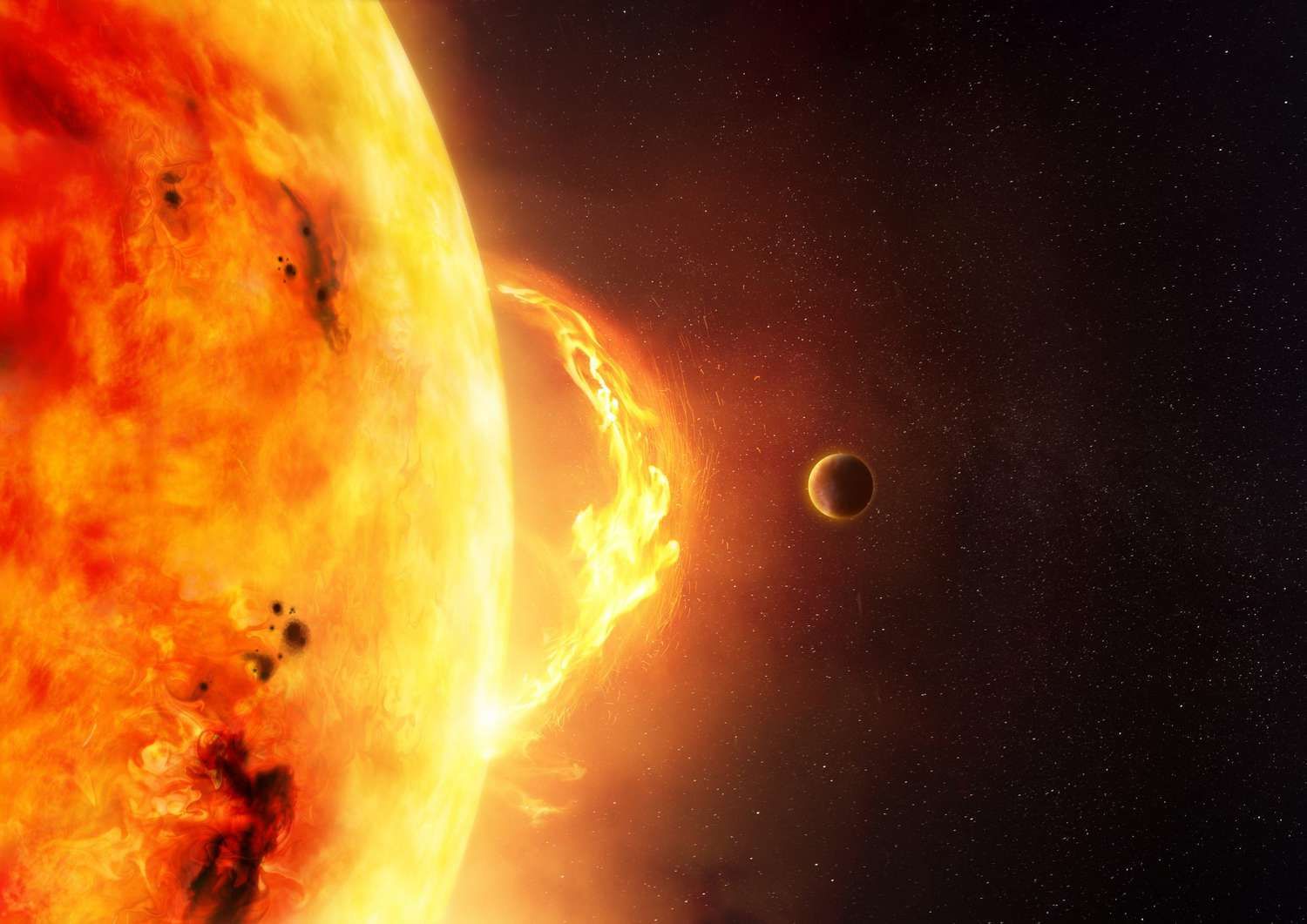
Not all disasters begin on Earth. The Sun has a temper. When it flares, the Earth feels it. One minute everything is fine. Then, in a flash lasting mere minutes, the Sun releases more energy than a billion nuclear bombs. We call it a solar flare.
What is a Solar Flare?
A solar flare is a sudden, intense burst of radiation from the Sun's surface, released when magnetic energy stored in the Sun's active regions suddenly discharges all at once. Active regions are areas of intense magnetic activity on the Sun's surface; as discussed in Sunspots Explained. Sunspots are the most visible markers of these regions, where powerful magnetic field lines push up through the Sun's surface, emerging at one point and looping back in at another, much like the north and south poles of a bar magnet. The energy stored in these magnetic fields is the same kind of force that makes magnets attract or repel each other, except on a scale incomparably larger. Now, the Sun's surface is never still; plasma is constantly moving, churning, and shifting beneath and around these magnetic structures, and that constant movement pulls and strains the field lines over time. When the stress builds beyond what the magnetic structure can sustain, the field lines snap and reconnect in a fraction of a second, releasing all that stored energy in one sudden burst. That burst is a solar flare.
How fast do they hit Earth?
Solar flares are the Sun's equivalent of a lightning strike, in that they appear suddenly, carry intense energy, are over in minutes, and leave consequences that outlast the event itself. The radiation they release travels at the speed of light, covering the approximately 150 million kilometres between the Sun and Earth in just eight minutes; by the time the flare is detected, its effects are already on their way. What that leaves us with, practically speaking, is a very narrow window of response: monitoring systems can detect a flare the moment it occurs and within those eight minutes, operators can flag communication systems as unreliable, switch to backup channels, and brace for disruption. Eight minutes is not enough time to prevent the effects, but it is enough time to prepare for them.
What happens when they arrive?
When the burst of X-ray and extreme ultraviolet (UV) radiation from a solar flare reaches Earth, it collides with the upper atmosphere and dramatically disturbs a layer called the ionosphere, sitting roughly between 60 and 1,000 kilometres above Earth's surface.
The ionosphere is not just a layer of air. It is filled with electrically charged particles called electrons, tiny negatively charged particles that have been knocked loose from their atoms by the Sun's everyday radiation, the kind the Sun emits constantly even on its quietest days. Under normal conditions, the ionosphere maintains a relatively steady and predictable population of these electrons, and that predictability is what makes it so useful; radio signals bounce off it to enable long distance communication, GPS signals pass through it at a known rate, and the systems we depend on daily are engineered around that expected, stable behaviour.
When a solar flare arrives, the sudden surge of X-ray radiation dislodges far more electrons than usual, dramatically increasing the ionosphere's electron density. Think of it as the ionosphere suddenly becoming far more electrically charged than anything our technology was built to handle. Space-dependent communication and navigation systems were designed around the ionosphere's normal, stable electron population; so when that population spikes far beyond its usual range, those systems become unreliable. What that unreliability looks like in practice is explored in the Effects section.