What is Space Weather and Why Should You Care?

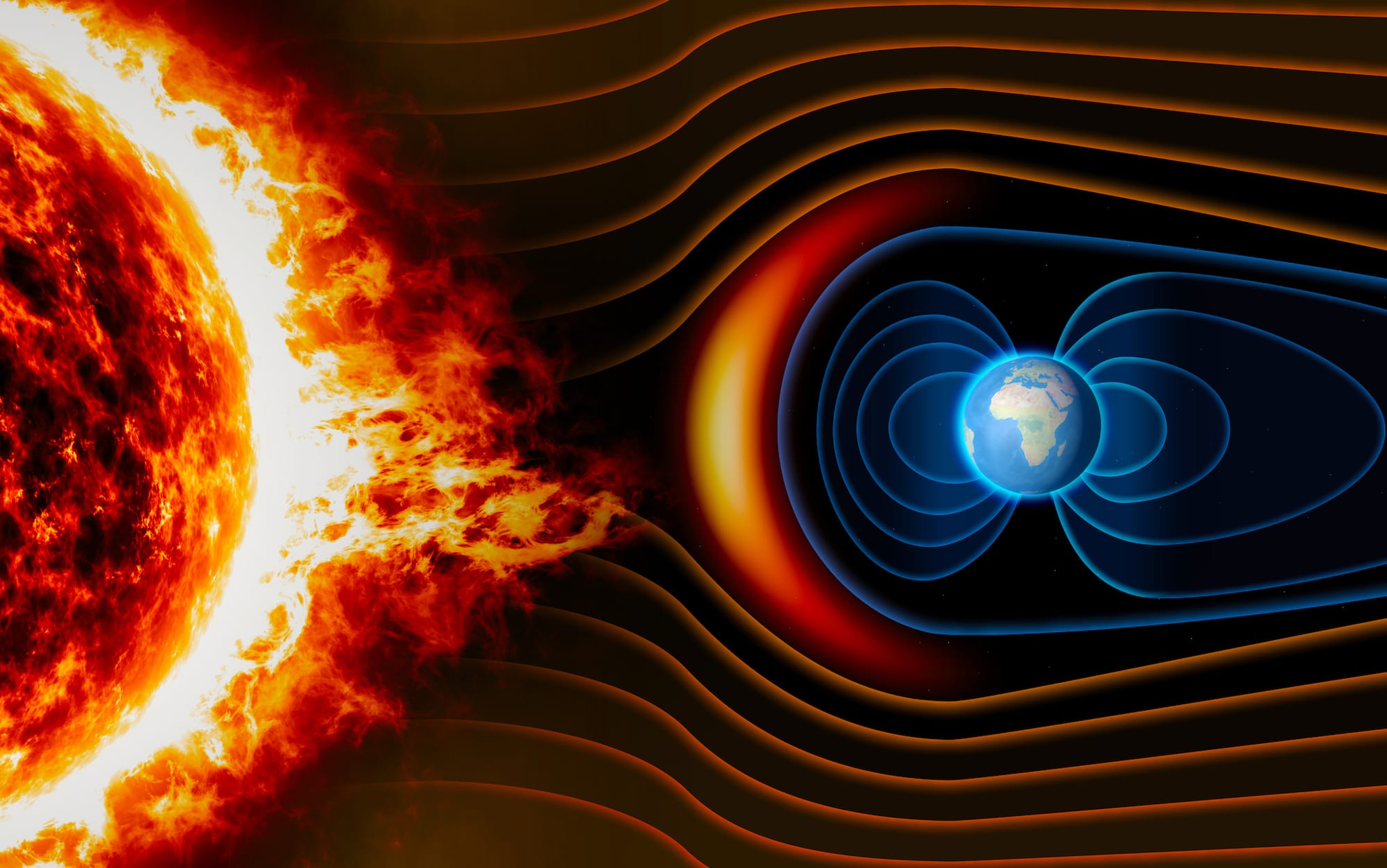
It has nothing to do with rain or sunshine, but it can disrupt your GPS, interfere with your radio communications, and degrade the satellite-dependent technologies you rely on every day.
Wait — weather in space?
When most people hear "space weather," they picture rain, sunshine, or temperature. Completely understandable, that's the weather we grew up with. Meteorologists call it terrestrial weather: the kind we check before leaving the house.
But there is another kind of weather. One that doesn't originate in Earth's atmosphere but begins 150 million kilometres away, at the surface of the Sun, travels through space at millions of kilometres per hour, and arrives at Earth carrying a force that shapes the technology-dependent world we live in.
It is called space weather; and whether you know it or not, it is already affecting your life.
So what exactly is space weather?
Space weather refers to the changing physical conditions in near-Earth space, from roughly 100 km above Earth's surface, extending outward into interplanetary space, driven primarily by the activity of our Sun.
The Sun is not a quiet, stable ball of fire. It is a dynamic, ever-churning, frankly moody (pun intended) mass of plasma and magnetic energy that constantly flings radiation, charged particles, and magnetic fields out into space, and toward us.
From the sun to your satellite signal
These solar emissions (commonly known as space weather phenomena/events) interact with Earth's magnetic field and upper atmosphere as they travel through space, and during their intense periods they produce very real and very measurable consequences on both space and ground infrastructure.
Let's start with space infrastructure: consider satellites, the very ones we depend on for communication such as Starlink and for positioning, navigation and timing such as GPS. During moderate to intense space weather conditions, they are affected in two ways.
First, the satellite itself can experience increased atmospheric drag, surface charging, and solar panel degradation, all of which shorten its operational life and may lead to de-orbiting. Second, the signals it transmits can suffer time delays and fluctuations in signal strength and frequency, reducing the quality and accuracy of every application that depends on them, from the map on your phone to the timing systems used by emergency services.
It doesn't stop there. Ground infrastructure is also vulnerable to these space weather effects. For example, power grids can experience sudden surges and outages, while high-frequency (HF) radio and radar systems, used in aviation, maritime navigation, and defense, can suffer signal blackouts or severe interference.
Think of it this way: just as terrestrial weather shapes what you wear and how you travel on Earth's surface, space weather shapes how reliably your GPS works and how dependable your radio communications are.
The main space weather culprits
These space weather phenomena come in different forms, each with its own character and consequences. They include solar flares, which originate from active regions of the Sun known as sunspots, coronal mass ejections (CMEs), coronal holes, and high-speed solar wind streams. Each of these is discussed in detail under the tag 'Meet the Key Players of Space Weather.'