Sunspots Explained

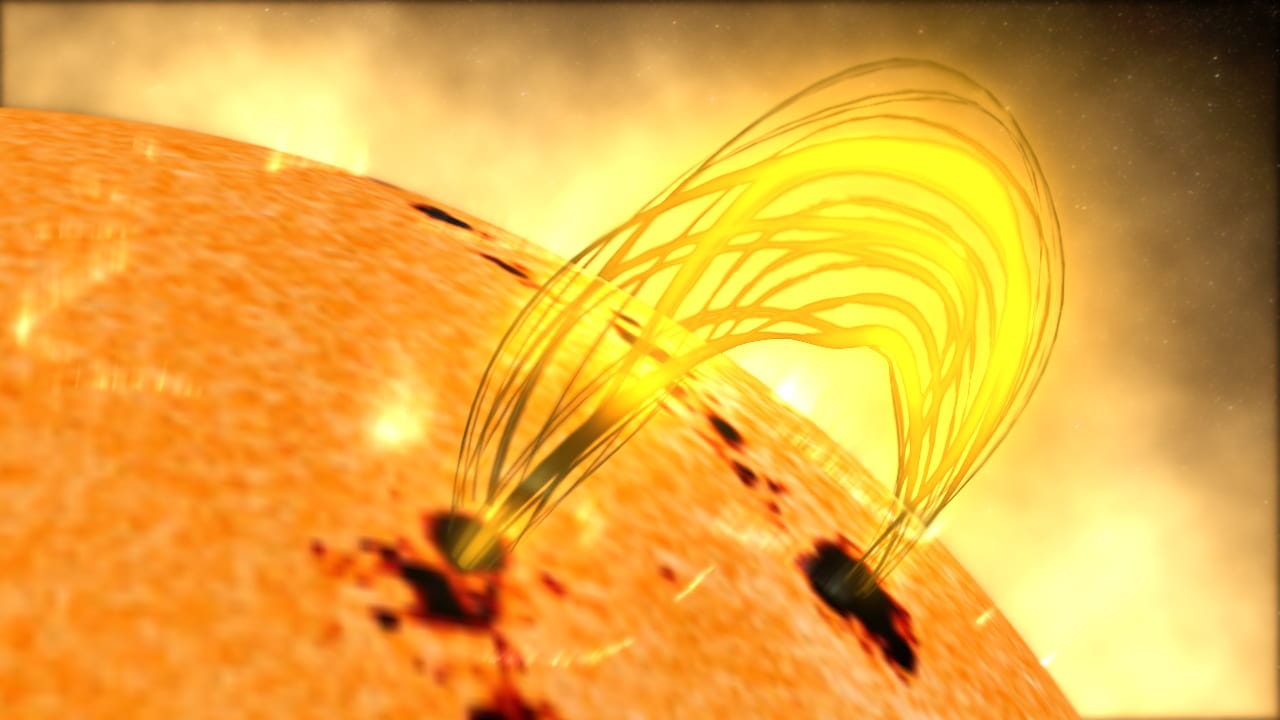
Have you come across a real telescopic image of the Sun, and noticed dark patches scattered across its surface? If you have, you were looking at sunspots. And before you ask, no, the Sun is not bruised. Not spotty either. Well, actually, a little spotty.
What exactly are sunspots?
Sunspots are temporary regions on the Sun's surface that appear darker than their surroundings because they are cooler. While the rest of the Sun's surface burns at around 5,500 degrees Celsius, a sunspot sits at a relatively cooler 3,500 degrees Celsius. Cooler, yes, but still hot enough to melt virtually anything we know of on Earth.
So why are they cooler? The answer lies in magnetism, the Sun itself is a deeply magnetic object; its entire body generates vast, complex magnetic fields produced deep within its interior through the constant churning of electrically charged plasma. These magnetic fields run throughout the Sun, but in most places they remain submerged and orderly beneath the surface. Sunspots, however, are specific regions where concentrated, unusually powerful magnetic fields force their way upward and break through the Sun's surface, creating a localised disturbance unlike the surrounding area.
As these intense magnetic fields push through, they suppress the normal flow of hot plasma that would otherwise rise freely from below the Sun's surface. To understand why this matters, consider that the Sun's surface, known as the photosphere, is continuously heated by hot plasma rising up from the interior, the same way heat rises in boiling water. It is this constant upward flow of plasma that keeps the surface blazing at around 5,500 degrees Celsius. But where a sunspot forms, the strong magnetic field acts like a partially blocked vent, interrupting that rising flow of plasma before it can fully reach the surface. The heat builds up below but cannot get through as freely, so that patch of the surface remains significantly cooler than its surroundings. And because it is cooler, it radiates less light, which is why it appears darker to our eyes; not because it is actually dark, but because the blazing regions around it are so much brighter by comparison.
To be precise about what’s actually happening here: the sunspot’s magnetic field breaks through the surface, but rather than releasing the heat beneath it, its very presence acts as a barrier that prevents the hot plasma below from rising freely, which is why the surface above remains cooler. If that field were to weaken or disperse entirely, the suppression would lift, hot plasma would flow freely again, the surface temperature would equalise with its surroundings, and the sunspot would disappear.
They always come in pairs
Sunspots rarely appear alone. They typically come in pairs, with one acting as a magnetic north pole, where magnetic field lines emerge from the Sun's interior, and the other as a magnetic south pole, where those same field lines curve back and re-enter the Sun. Think of it as two ends of a giant magnet embedded just beneath the Sun's surface.
Sunspots also frequently appear in groups, and even in large, complex clusters, every single sunspot carries a specific magnetic identity: it is either a north or a south. There are no neutral spots. Each one is either a source of magnetic flux or a sink for it.
These groups often start as a simple pair and grow more complex as the magnetic field becomes tangled and fractured over time. Within a group, sunspots organise themselves into two broad camps: leading sunspots and following sunspots. The leading spots tend to cluster together, sit further ahead in the direction of the Sun's rotation, and are generally larger, more symmetrical, and more stable. The following spots trail behind, are more fragmented, and carry the opposite magnetic polarity to the leaders.
The short lifespan of a sunspot
A sunspot is not permanent. It can last anywhere from a few days to several months before the magnetic field that created it weakens and it simply fades away. Some grow to staggering sizes. The largest sunspot ever recorded, observed in April 1947, was 330 times the size of the entire Earth and was visible to the naked eye from Earth's surface. The sunspot group was first observed in early February 1947 and grew in size, reaching its maximum size and visibility in early April 1947
It is also worth noting that because the Sun rotates, sunspots move across the Earth-facing side of the Sun over time. This matters for space weather: a sunspot group that is powerful but positioned on the far side of the Sun, or rotating away from us, is far less likely to send its activity directly toward Earth. Timing and geometry, it turns out, are everything.
Sunspots run on a schedule: an 11-year one
Here is where it gets particularly interesting for space weather. Sunspot activity is not random. It follows a roughly 11-year rhythm known as the solar cycle, and space scientists have been officially numbering these cycles since the first recorded one began in 1755.
At the start of each cycle, the Sun is relatively quiet, with very few sunspots visible. As the years pass, activity gradually picks up, sunspots become more frequent and appear at lower latitudes on the Sun's surface, and things get busier and busier until roughly the midpoint of the cycle, known as solar maximum. This is the Sun at its most active, its most expressive, and frankly its most unpredictable. After that, activity slowly winds down again toward solar minimum, and the cycle begins afresh.
We are currently in Solar Cycle 25, and as of 2026, we are within the solar maximum range. Interestingly, solar maxima do not always arrive as a single clean peak. Solar Cycle 25 has displayed what scientists call a double peak, two bursts of heightened activity rather than one.
In 2024, sunspot numbers reached their highest count in over 20 years, with the official daily count reaching 299 on August 8th according to SILSO, the World Data Center for sunspot index, driving some of the most intense space weather activity in years.
Whether the cycle has fully peaked or has one more surge left in it is something the solar science community is watching very closely right now.
Why sunspots matter for space weather?
Sunspots are not just pretty dark patches. They are the birthplace of some of the most powerful space weather events we know. Solar flares, which are sudden intense bursts of radiation, originate from the magnetically active regions around sunspots; when the magnetic field lines in these regions become twisted and stressed beyond a certain point, they snap and reconnect violently, releasing enormous amounts of energy in the form of X-rays and extreme ultraviolet radiation in a matter of minutes. The full anatomy of a solar flare and what it means for Earth is discussed under Solar Flares Explained.
Coronal mass ejections, which are massive clouds of plasma and magnetic field that can disrupt satellites and power grids, are also frequently launched from sunspot regions; unlike flares, they are not just bursts of radiation but actual physical material ejected from the Sun's corona, sometimes carrying billions of tonnes of plasma into space at speeds of up to 3,000 kilometres per second. Their journey towards Earth and the consequences they carry with them are covered fully under Coronal Mass Ejections Explained.
In other words, when you see a large sunspot group rotating into Earth's view on the Sun's surface, the space weather community pays close attention. It is the Sun clearing its throat before it speaks, and sometimes it speaks very loudly.
The long history of sunspot watching
Humans have been watching sunspots for a very long time, long before telescopes existed.
Chinese astronomers were recording sunspots as far back as 800 BC. They could see them during hazy or smoky conditions, when a thin veil of dust or mist in the atmosphere dimmed the Sun just enough for the naked eye to make out the largest dark patches on its surface, without being blinded. This was not something that happened on a clear day. The atmospheric filtering did the work that a telescope lens does today.
In Europe, Galileo Galilei was among the first to study sunspots systematically through a telescope in the early 1600s. He was not alone, multiple scientists across Europe pointed their telescopes at the Sun around the same time, which promptly caused a heated dispute over who discovered what first. Scientists arguing over credit: truly a timeless tradition. What made Galileo's contribution particularly significant, however, was his insistence that the spots were actually on the Sun's surface, not objects passing in front of it. His observation that the Sun had imperfections was considered controversial, since the prevailing view held that the Sun was a perfect, unchanging, unblemished body. Sunspots quite literally complicated that idea. It is also worth noting that Galileo later went blind, likely partly from years of solar observation. A cautionary tale the satellites have since resolved for us.
It then took centuries of careful observation before the 11-year solar cycle was discovered in 1843 by German astronomer Samuel Heinrich Schwabe; and here is the detail that deserves its own moment.
Schwabe was not a professional astronomer. He was an amateur, a man with a telescope, a notebook, and an almost unreasonable amount of patience, who spent 17 years counting sunspots before the pattern revealed itself. Patience, it turns out, is a scientific superpower.
Now we have satellites doing what Schwabe did with his notebook. The tools changed. The curiosity never did.